
Warm or cool light for a bedroom?
A bedroom is the one room where the color of light is felt as much as seen. Warm light tells the body it's evening; cool light tells it to stay alert.
Kelvin in one minute
Bulb color temperature is measured in Kelvin. Lower numbers look warmer, more yellow and orange. Higher numbers look cooler, more blue and white. A candle sits around 1800K. Midday daylight is around 5500K. The bulbs you buy for home use sit between those two, usually 2200K to 4000K.
The bedroom default: warm
For a bedroom, 2700K or below is the starting point. This is the warm end, reading as candlelight, then fire, then early evening. The body associates that range with winding down. Cooler light in the same room at the same hour pushes the nervous system in the other direction.
Hotels that get lighting right almost always put 2700K bedside lamps in their rooms, never 4000K. The room is meant to feel like a place you go to stop, not a place you go to get something done.
When cool light belongs in a bedroom
Two cases.
A dressing or makeup area. If you apply makeup or shave in the bedroom, task light there needs to read close to daylight so colors look right. 3500K to 4000K.
A reading corner that doubles as workspace. If the bedroom is also a home office nook, task light for reading can sit at 3000K to 3500K. Warmer than daylight, cooler than the rest of the room.
The trick in both cases is zoning. The ambient light stays 2700K or below. Only the specific task zone goes cooler.
Dimming softens the question
Most of the tension between warm and cool disappears if your bulbs are dimmable. A 2700K bulb dimmed to 30% feels even softer and more amber. A 3500K bulb dimmed to 30% shifts down toward 2900K in perceived warmth. Dimming pushes perceived temperature toward the warm end, which is why restaurants dim warm bulbs rather than install cooler ones.
For a bedroom, the practical combination is: 2700K bulbs throughout, on dimmers wherever possible, and a single cooler task light (3000K to 3500K) near the mirror or desk if those zones exist.
Layering the room
Bedrooms read better without bright overhead light. Most work with the overhead off and two or three lower-level sources on: a bedside table lamp, a wall sconce on the opposite side, maybe a floor lamp in a corner. Each one warm, each one dimmable, each one doing one job well.
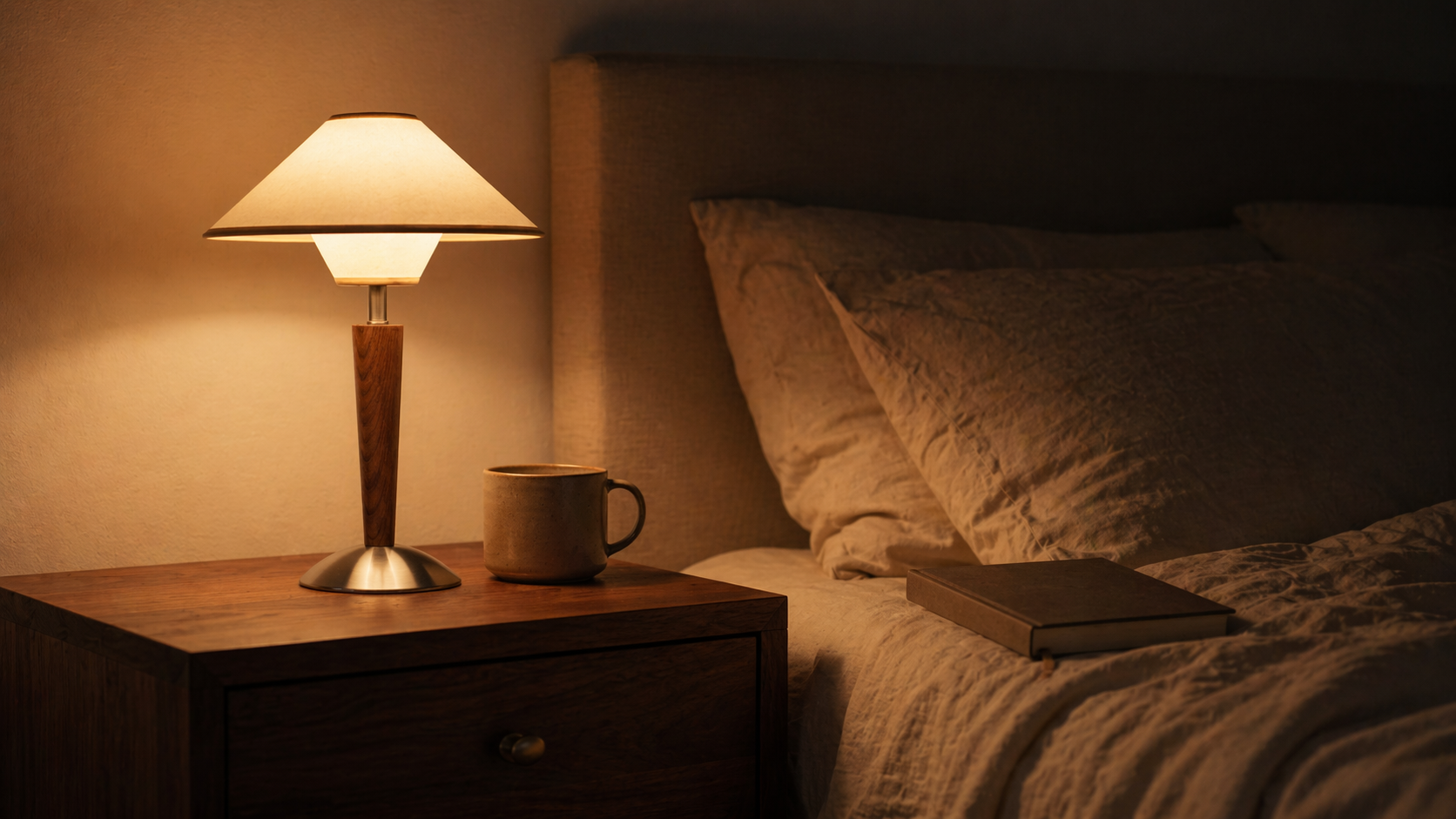
Our Tavira lamp is one we keep returning to for bedsides. A fabric shade in beige, tan, or green on a turned wooden base with a brushed metal stem. Classic bedside form, with the fabric diffusing a 2700K bulb into the soft even light this room wants.
A good starting pair: one lamp like that at arm's reach from the bed, and a wall sconce above the bed on the partner's side, so you're never reaching across the bed for light. Browse table lamps for bedside options.